DYNAMIC WEBBING BREAKTESTS 2024

A report about our internal test results and conclucion

2024

INTRODUCTION

We already published a first video to show the main differences in behavior of a tied backup and a backup connected by a linelock (FALL TEST VIDEO). Dynamic testing is a possibility to get closest to simulating the realities of a (backup) fall than during so-called static tests on a traction bench. Most standardized climbing ropes are currently tested this way (dynamic). Many of you have asked us for more precise data from our previous testing, so we have carried out a full test-series of situations allowing us to understand a little better the dynamic behavior of our slackline webbings in our mechanical blockers (weblocks, linelocks, optimized linelocks like a square linelock or our future diamondlock) but also by simply attaching webbings by a knot, as is frequently the case in highline.

PROTOCOL

“We have been fortunate to be able to access an industrial building equipped with an overhead crane allowing us to lift our test mass quickly and with quite good precision. 77 falls were necessary to carry out this study.

All tests have been executed the same way and following the same protocol:

Weight of the rigid mass (steel filled with sand): 95 kg
Drop height of the mass : 145 cm Webbing length : 60 cm
Fall factor: 2,4 1st

1st Note: To ensure that the webbing is well positioned in the weblock during the fall, we used the anti-slip on all the 25mm webbings, and re-inserted the webbingtail behind the central sheave, on the thin webbing. The slackibloc slim does not allow the metallic anti-slip fro 20mm webbings.
2nd Note: For thin webbings like the SkyD and the Green Mamba, the linelocks have always been positioned in the axis of their smallest dimension, this is the position that they take naturally during handling.

In order to conduct these tests, we decided to go purposely very far towards rather extreme situations, which do not correspond to the majority of cases encountered in highline but in order to consider the worst imaginable scenario.

To give you an idea, in our 'lab' tests, the skyD resisted shocks of 20kN with major damage, but only 1 breakage among the 4 tests on a linelock. In the case of a real backupfall example, we did a simulation during the last MHP Festival using a 55m long highline with a SkyD backup, secured with a linelock and a falling mass of 88 kg. The measured forces in the backup had reached around 8kN and the webbing did hold the shock without damage.

EVALUATION OF THE RESULTS:

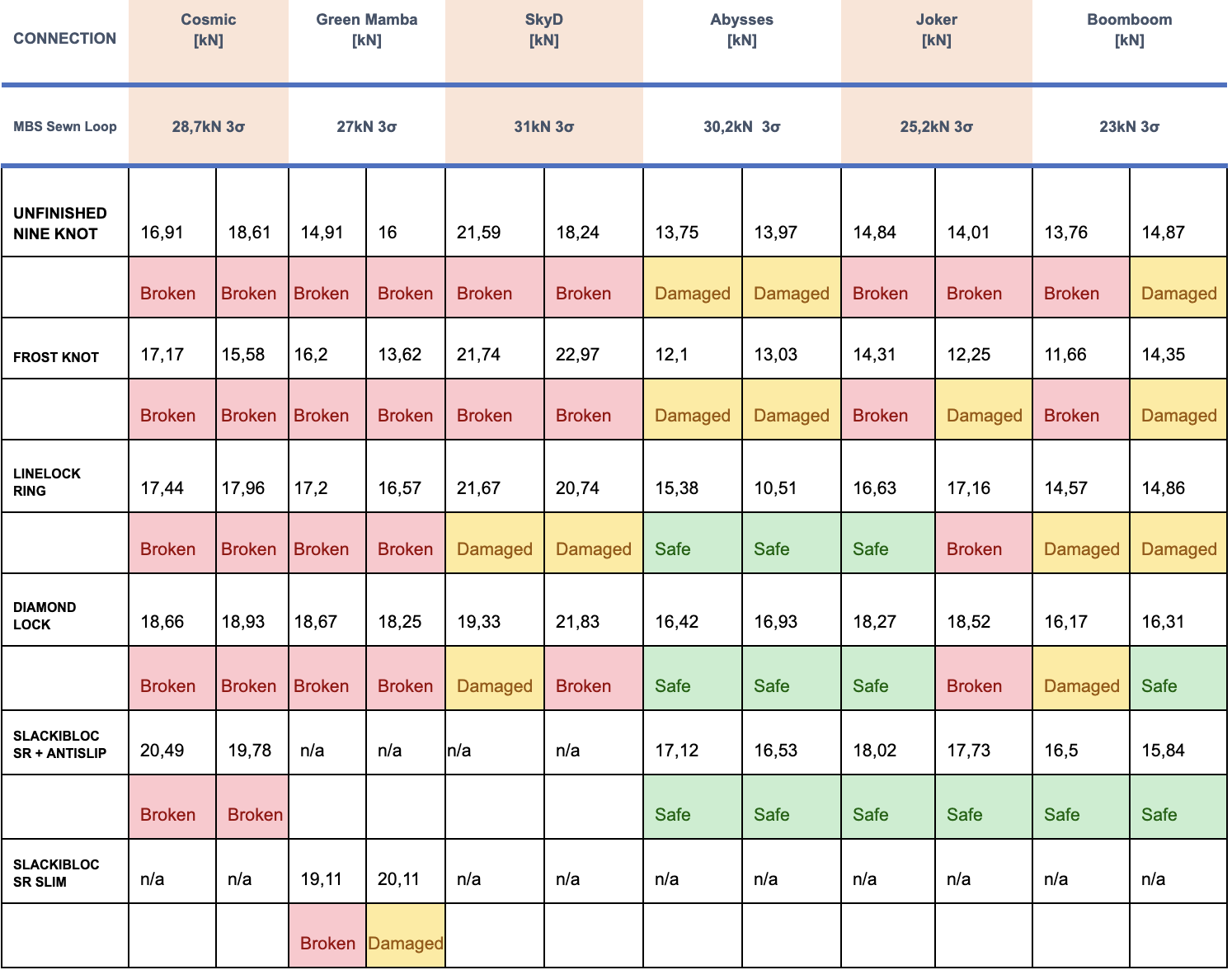
Below you will find a chart summarizing all of our tests. In this paragraph I will offer you an analysis of these results based on my technical knowledge and my experience (Florent B., engineer and developer at SlackInov’);

Most resistant webbing in drop test:
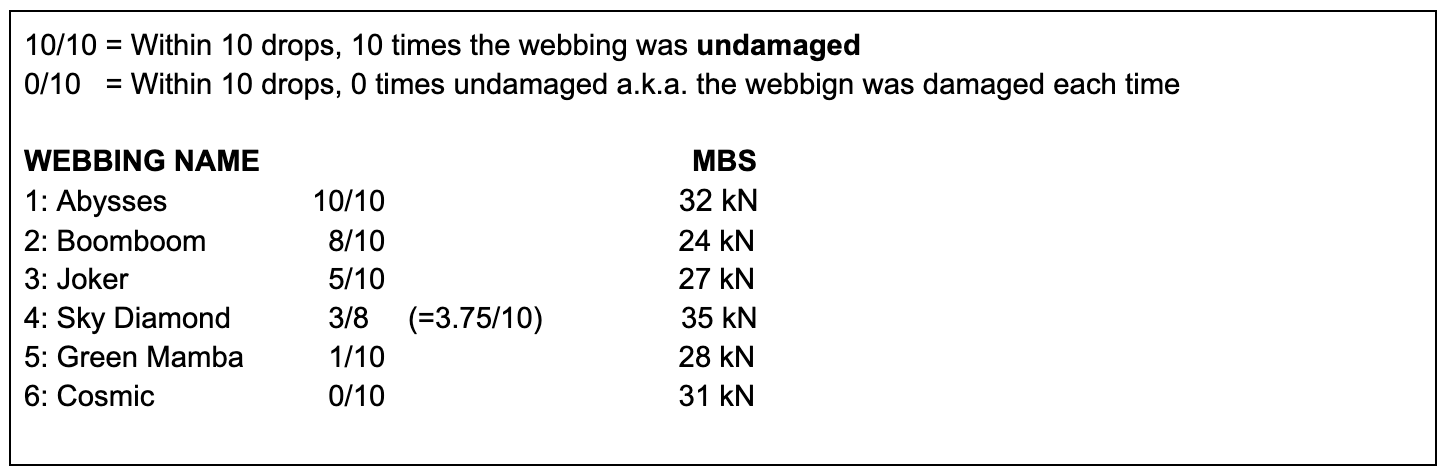
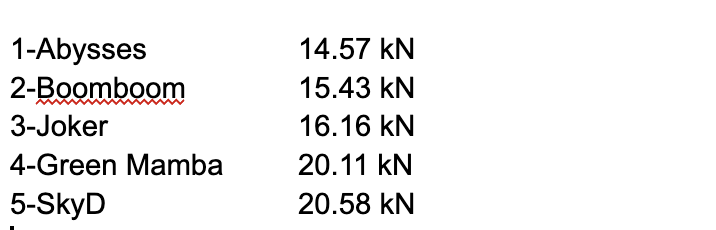
I have classified the 5 webbings tested by their ability to withstand falls without breaking or being damaged.

The most resistant of all being the Abysses, which resisted all the falls without breaking regardless of the types of connection used:

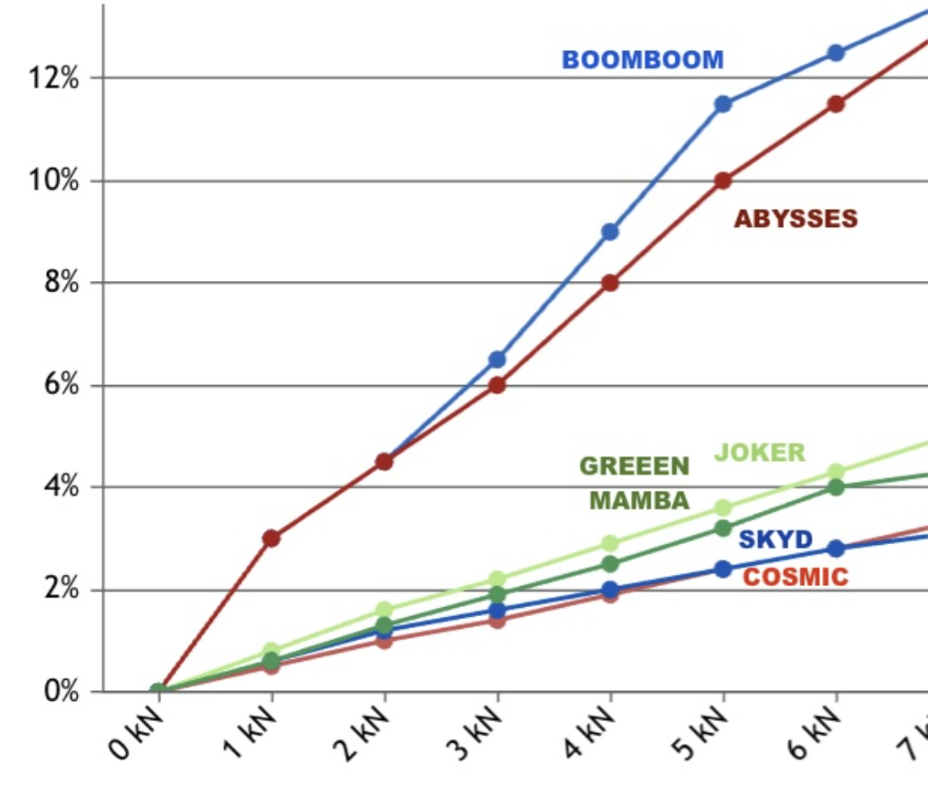
TESTED WEBBING STRETCH

Looking at these results, we understand that the more stretchy a webbing is, the more capacity it will have to stretch wider to absorb the shock without breaking. This is why our 2 polyamide straps perform better than polyester or dyneema webbings. A webbing with a very high breaking strength like the SkyD for example (35 kN MBS), ultimately finds itself much less dynamically resistant than the Boomboom which has the lowest breaking strength within our samples. Webbings with a “core + sheath” structure (joker, abysses, SkyD) of which certain fibers remain inside protected by others, also seem to behave better dynamically than other webbings with a more basic weave, whether they are flat or tubular.

MOST RESISTANT CONNECTORS IN OUR DROP TEST:

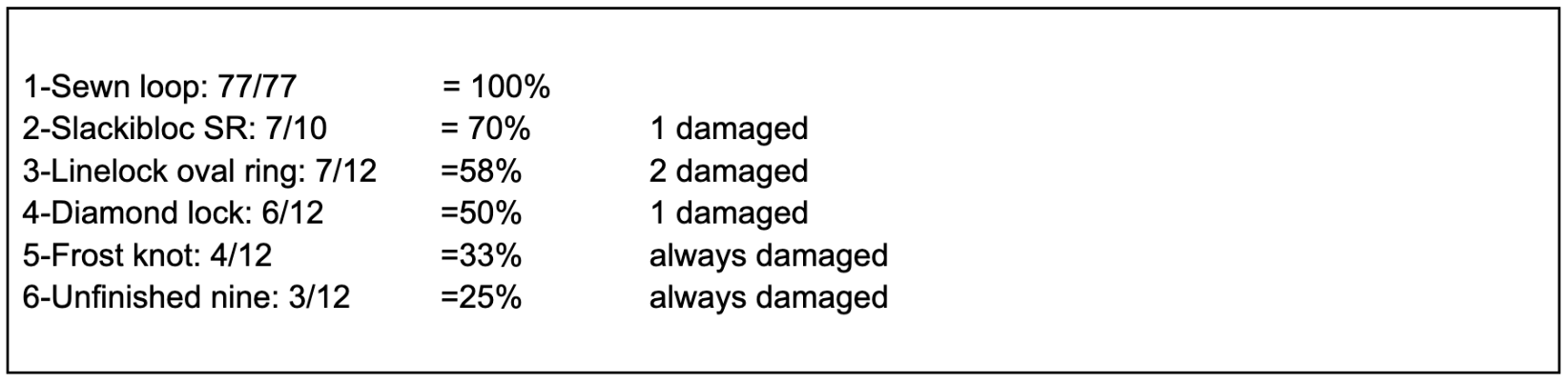
Among all the falls made each time we tested a knot or an ascender, the other end of the webbing was connected to the anchor by a sewn loop. None of the sewn loops broke in two days of testing and 77 falls, even for webbings like the joker, whose resistance is greater in a weblock than the sewn loops.

>This overall result allows me to confirm that in slacklining the most suitable connector for dynamic shocks remains the sewn loop.

The results seem to give the advantage to the use of weblocks, it is the preferred option on long lines and depending on the type of installation and the tension of the backup, on lines that move a lot like in a trickline for example it sometimes happens that the weblock, which is heavier, moves a lot and can sometimes even hit the of the mainline, a rock or other obstacles in which case a linelock would be more suitable.

We notice without surprise, that there is a big difference in resistance between knots and blockers, whatever they may be.

At Slack Inov', we continue to believe that the use of backup knots in highline represents a potential danger and we’d therefore like to prohibit its use on our webbings.

Also, it seems to be presented that our upcoming DiamondLock (a square linelock) seems to weaken the webbings more than our classic linelock. I think in reality though, the behaviour of the two is very quite similar, and we just haven't concluded enough different tests to declare or prove it indefinitely.

WEBBINGS THAT BEST ABSORBED THE SHOCK (only included when webbing did not break)

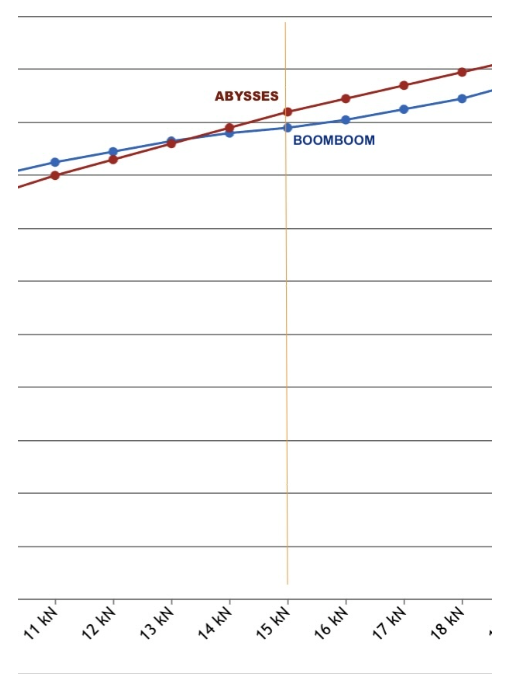
Without surprise, this classification corresponds exactly to the elasticity of the webbings. The more elastic/stretchy the webbing, the more it will absorb the shock caused by a fall. For those who seem to be surprised to see the Abysses ranked better than the Boomboom, you will notice looking at the stretch curve at 15kN, the Abysses is in fact more elastic than the Boomboom.

MOST PREDICTABLE CONNECTOR (lowest standard deviation)

The standard deviation roughly corresponds to the average difference in measurement between two identical simulations.

The lower the standard deviation calculated for a connector, the less risk there is of a big surprise with a breaking value that's very different from our predictions

1.59 kN Diamond Lock

1.66 kN Slackibloc

2.44 kN Unfinished nine

2.88 kN Linelock ring

3.66 kN Frost knot

If in the previous ranking of connectors we might have found the Diamond Lock a bit overshadowed, here we notice that it is in fact the most reliable connector in our tests. Used smartly (knowing that its strength will be lower than that of a banana), it remains, in my opinion, the best compromise for connecting a backup to the anchor when a sewn loop is not feasible. Not to mention that its double width (wide and thin webbing) makes it a very versatile product.

CONCLUSION

These tests are very interesting for us because they allow us to expand our knowledge, which is currently limited to the behaviour of products under static loads.

For instance, in the case of bananas, we notice that in dynamic situations, the webbing breaks at about two-thirds of the load at which it breaks statically, which is significant.

When it comes to using our webbings for backups, the most significant stress will occur during backup falls, which are dynamic events. "However, these values and rankings need to be considered in context.
For instance, on long lines (from 200m to several kilometers), the fall factor will be very low while the risk of very high tension due to a gust of wind will clearly increase.

Therefore, it would be better to prioritize the static strength of the webbing over its dynamic strength. And especially its width because a thin webbing is much less sensitive to wind than a wide one.

Another scenario is the midline, where the space clearance (distance between the slackliner and the ground) is low. A highly elastic webbing like the Abysses will provide excellent cushioning, but the risk is that it may touch the ground when stretched during a backup fall.
In these two scenarios, the Green Mamba and SkyD backup webbings make perfect sense."

Furthermore, we strongly advise against using knots to connect your backups. If the choice of knot was made for financial or weight reasons, consider using a linelock instead. Stay safe everyone and let’s consider always thinking twice about the right choice of main and backup webbings for each setup, instead of going with simply what’s quickest available among a group of highliners.

Stay safe everyone and let’s consider always thinking twice about the right choice of main and backup webbings for each setup, instead of going with simply what’s quickest available among a group of highliners.

EXTRA NOTE by Florent B: 

"Those tests were also really helpful for some important calculations that may help us and the community, to have a clear idea of how strong and safe is your setup whatever is the situation:

-how short can be my highline without being dangerous?

-how long can it be?

-is it necessary to split this highline?

-if yes, with which length of splits?

-My new freestyle line is really weak in MBS, however its elasticity is so huge, does it compensate in terms of safety?

... We are still working on concluding those calculations up to a 100%, but hope to be able to present those to you during the summer!"